


Miami Wedding Photographer & Videographer: Best Options for Your Wedding
March in Miami has a quality that’s easy to underestimate until you’re standing in it. The humidity hasn’t arrived yet, the light is clear without being harsh, and the city moves at a pace that feels more open than what the summer months bring.
For couples planning a spring wedding, it’s one of the most reliable windows the calendar offers, and Dijana and Nicholas found that out firsthand on March 16th at the Mondrian South Beach.
The Mondrian sits on West Avenue along Biscayne Bay, its façade designed by Marcel Wanders with the kind of visual intention that translates directly into photography and film.
The waterfront location means that late afternoon light comes in low and sideways across the water, and the architecture provides geometry that works well at almost any hour. It’s a venue that rewards a photographer and videographer who pay attention to both.
Miami wedding photography and videography requires a specific kind of adaptability. The city is visually generous: water, architecture, color, and light are everywhere, but that generosity comes with contrast. Bright midday sun, intense reflections off the water, and the shift between outdoor heat and air-conditioned interiors all create conditions that separate consistent coverage from coverage that only works under ideal circumstances.
This guide covers what couples planning a Miami wedding most need to know before they book, from venue selection and timeline planning to how the season you choose shapes everything your photographer and videographer will be working with.
Where Miami Couples Are Choosing to Get Married
Miami’s venue landscape is as varied as the city itself, and the choice of setting shapes the visual tone of a wedding more here than almost anywhere else. Waterfront, garden, historic estate, and boutique hotel weddings all exist within a short drive of one another, and each produces a distinct kind of imagery.
Mondrian South Beach on West Avenue offers one of the most architecturally distinctive settings in the city. The bay-facing ceremony space frames the water behind the couple, and the hotel’s interior design carries through from the lobby to the reception areas in a way that photographs with real consistency. It’s a venue that has strong visual identity from morning through evening.
In Coconut Grove, Vizcaya Museum & Gardens brings a level of architectural grandeur that few venues in South Florida can match. The Italian Renaissance estate and its formal gardens create portrait opportunities that feel more European than tropical, and the combination of stone, water features, and lush overgrowth gives the setting a layered quality in both photography and film.
For couples drawn to the elegance of Coral Gables, The Biltmore Hotel delivers a classic ballroom experience with grand proportions and warm interior light. The surrounding grounds extend that visual range outdoors, and the architecture holds up well across seasons.
The Betsy Hotel on Ocean Drive offers a more intimate scale in the heart of South Beach, while The Vagabond Hotel in the MiMo Historic District brings a mid-century aesthetic and a neighborhood feel that appeals to couples looking for something less conventional. Both venues reward a documentary-style approach to coverage.
What Sets a Miami Wedding Apart Visually
Every city has a visual signature, and Miami’s is built on contrast. The brightness of the light against the water, the saturated colors of the architecture, and the way the evening shifts from golden to deep blue in a matter of minutes all create conditions that are distinct from anything in the Midwest or the Pacific coast.
That contrast is an asset when it’s understood and planned for, and a challenge when it isn’t. Backlit ceremony settings with water behind the couple require a different exposure strategy than shaded garden portraits, and the transition from outdoor heat to a cool interior reception introduces its own set of technical demands. The best Miami wedding photography handles all of it without the approach feeling inconsistent across the day.
Miami weddings also tend to carry a strong sense of personal style. The city’s cultural mix, its fashion sensibility, and its architectural backdrop encourage couples to arrive with a clear visual perspective, and the coverage is stronger when the photographer and videographer are working in alignment with that rather than imposing their own aesthetic on top of it.
The other thing that distinguishes Miami weddings is the international dimension. Many couples have guests traveling from Latin America, Europe, or both, and the celebration often reflects that range. A wedding day that tells that story fully requires coverage that moves fluidly from intimate getting-ready moments to a reception floor that reflects the energy of a genuinely mixed group of people.
If you are planning a wedding at the Mondrian South Beach or another Miami venue, we would love to hear about your day. If you’re planning a wedding at the Mondrian South Beach or another Miami venue, Reach out to start the conversation!
How to Choose a Miami Wedding Photographer Who Knows the Light
Miami’s light is not forgiving to a photographer who relies on a single approach. The midday sun is intense and direct, the golden hour is brief and moves fast, and the shift from outdoor to indoor settings can be dramatic. Reviewing a photographer’s work specifically in Miami conditions — not just in well-lit studio setups or overcast northern light — tells you a great deal about their actual skill set.
When evaluating Miami wedding photographer portfolios, look for images made in full sun as well as in low light. Reception coverage under string lights or candlelight, ceremony images with bright sky behind the couple, and portrait work during the transition between outdoor and indoor settings are all conditions you should see handled well before you book.
The same standard applies to videography. Miami wedding videography that holds up over time is built on strong audio capture and natural movement, not just visual beauty.
Ceremony vows, toasts, and speeches are the parts of the film that couples return to most, and those moments require a videographer who prioritizes clear sound alongside compelling footage.
We deliver a full-length feature film alongside the highlight film for every wedding, because the complete story of a day — the ceremony in full, every speech, the texture of the reception — deserves more than a compressed edit.
Building a Miami Wedding Timeline That Works With the Water and the Heat
The Miami wedding day timeline is shaped by two forces more than anything else: the light over the water and the heat of the afternoon. Understanding how those two elements move through the day is the most useful thing a couple can do before finalizing their schedule.
For waterfront venues like the Mondrian South Beach, ceremony timing relative to sunset matters enormously.
A ceremony that ends thirty to forty-five minutes before sunset gives the portrait session access to the best light of the day, with the bay catching color behind the couple. That window is short and moves quickly, and a timeline that’s built around it produces noticeably stronger images than one that treats portrait time as flexible.
Afternoon heat in Miami is a genuine factor for outdoor portrait work, particularly from June through September. Spring weddings in March and April avoid the worst of it, which is one of the reasons those months are consistently the most in-demand on our calendar. Couples marrying in summer benefit from shifting outdoor coverage to early morning or the hour before sunset, when temperatures drop and the light softens.
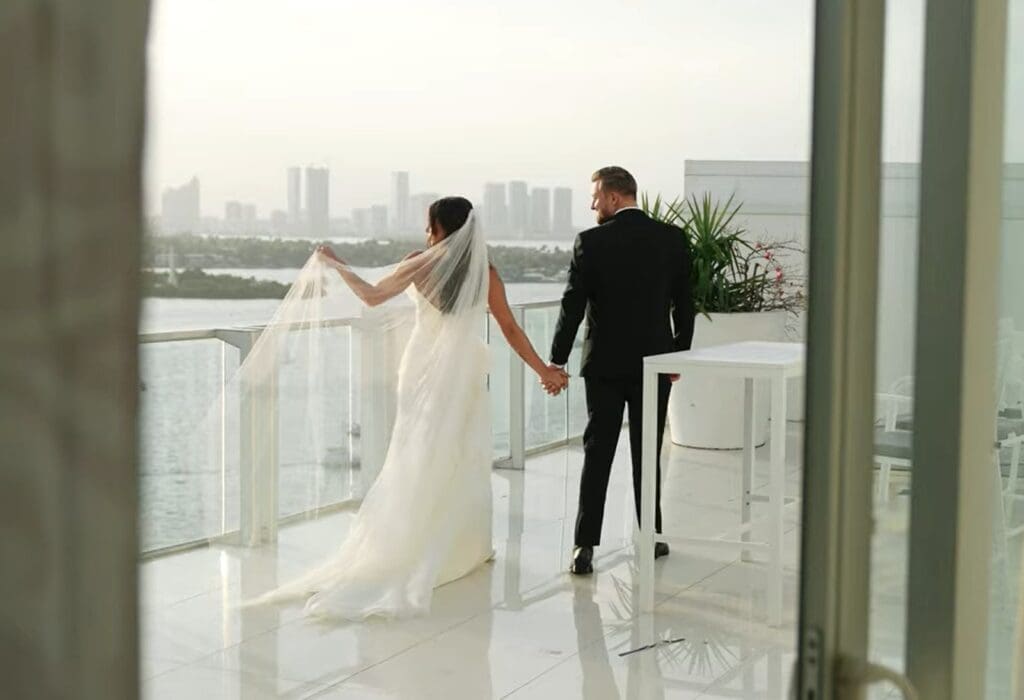
For Dijana and Nicholas’s March wedding, the timing worked naturally with the season. The late afternoon ceremony position on the bay gave the coverage access to a quality of light that wouldn’t have been available two hours earlier, and the transition into the evening reception held that warmth through the first dances.
What to Wear for a Miami Beach Wedding
Miami’s climate and visual setting reward clothing choices that are both considered and practical. What photographs beautifully in a temperate garden setting can read differently against the brightness of South Beach, and fabric choices that work well in spring can become uncomfortable by July.
Lightweight, natural fabrics in warm neutrals, soft whites, and earthy tones tend to photograph with the most consistency across Miami’s range of settings. Against the blues of the bay and the warm tones of South Beach architecture, those colors create contrast without competing. Bright white works well in shaded or interior settings but can blow out in direct midday sun, so timing matters.
For bridal parties, cohesion in tone rather than matching colors tends to translate best on camera, particularly in outdoor settings where the background is already visually complex. Dusty rose, sage, and warm ivory all hold well against Miami’s characteristic palette.
Grooms and groomsmen dressing for a warm-weather waterfront wedding benefit from lighter suites in linen or tropical wool, which read with the same formality as heavier fabrics but move and breathe in ways that keep the day comfortable. We work with couples ahead of the wedding to talk through how attire choices will interact with the venue, the light, and the visual approach of the coverage.
How Miami’s Seasons Affect Your Wedding Photography
Miami has a real two-season rhythm: a dry season that runs roughly from November through April, and a wet season from May through October. For couples planning an outdoor or partially outdoor wedding, that distinction matters more than almost any other scheduling consideration.
The dry season offers the most predictable conditions. Lower humidity, reliable sunshine, and the absence of afternoon thunderstorms make it the preferred window for waterfront ceremonies and outdoor receptions.
March sits near the peak of those conditions, which is a significant part of what made Dijana and Nicholas’s wedding day so visually clean from start to finish.
Summer weddings in Miami are entirely possible and can be beautiful, but they require more contingency planning. Afternoon rain is a near-daily occurrence during the wet season, and venues with strong indoor options become more important. The upside of summer coverage is the dramatic sky — storm light in South Florida produces a visual intensity that’s difficult to manufacture in post-production and, when it clears, gives way to some of the most vivid sunsets of the year.
Fall in Miami, particularly October and November, offers a transitional quality that some couples find compelling. The heat begins to ease, the rain becomes less reliable, and the light takes on a slightly warmer angle as the sun moves south. For couples flexible on date, late fall is an underrated window for Miami wedding photography that balances good conditions with lower vendor competition than the peak spring months.
Why Couples Choose Flower & Oak
Couples who work with us are typically looking for coverage that captures the full arc of their wedding day, not a selection of highlight moments. That means being present from the first moments of the morning through the last dance of the evening, and treating every part of the day with the same level of attention.
The full-length feature film is where that commitment shows most clearly. The ceremony is preserved in its entirety, including the vows and every toast and speech. Those are the words that were spoken once, in front of the people closest to the couple, and they deserve a permanent record that reflects their actual weight. The highlight film exists alongside the feature as a different way to experience the day, not as a replacement for it.
For a day as visually rich as a Miami waterfront wedding, that archive holds more than most couples expect.
Our photography and videography are designed to work together from the start of the day. The approach to movement, framing, and timing is coordinated so that the still images and the film tell the same story, and the couple never has to manage the friction of two teams pulling in different directions.
Frequently Asked Questions (FAQ)
Do you photograph and film weddings at the Mondrian South Beach?
Yes. The Mondrian is one of our favorite venues in Miami. The waterfront setting, the distinctive architecture, and the way the bay light moves through the afternoon all create strong conditions for both photography and videography. We’ve had the opportunity to document weddings there and know the space well.
What is the best time of year for a Miami outdoor wedding?
The dry season, from November through April, offers the most reliable conditions for outdoor coverage. March and April sit near the peak of that window, with mild temperatures, low humidity, and consistent light. If you’re planning a waterfront ceremony, those months also give you the best chance of a clean sunset over the bay.
How do you handle the intense midday light in Miami wedding photography?
It requires preparation and flexibility. We look for open shade, work with the direction of the sun rather than against it, and plan the portrait schedule around the light rather than treating it as fixed.
For outdoor ceremonies in full sun, we use exposure techniques that hold detail in both highlights and shadows, so the resulting images feel balanced rather than blown out.
Do you offer both photography and videography for Miami weddings?
Yes. We cover both, and the two are designed to work together from the start of the day. You receive a highlight film, a full-length feature film with the ceremony and speeches preserved in full, and complete photography coverage from morning through reception.
Planning a Miami Wedding?
If you are getting married in Miami and want wedding photography and videography that feel natural, present, and true to the day, we would love to connect.
Whether you are in the early stages of planning or already have a venue and date in mind, we are always happy to talk things through. Reach out to start the conversation.
