


Golden Hour Wedding Shots: When It Is and How to Plan For It
Every wedding photographer and videographer has the same favorite twenty minutes of the day, and it isn’t the ceremony.
It’s the stretch right before sunset, when the light goes low and warm and soft, and suddenly everything looks like it was lit on purpose. Golden hour. It’s the difference between portraits that look nice and portraits that stop you when you scroll past them years later.
Here’s the catch: it happens at a fixed time, it doesn’t wait, and if it isn’t written into your timeline you will miss it. Most couples who miss golden hour don’t miss it because of weather. They miss it because nobody put it on the schedule.
Here’s what it actually is, when it happens, and how to make sure you get it.
Jump to:
- What golden hour actually is
- When golden hour happens on your wedding day
- How much time you actually need
- Where it goes in your timeline
- What if your ceremony is at sunset?
- What if the weather doesn’t cooperate?
- Blue hour, the underrated sequel
- FAQs
What Golden Hour Actually Is
Golden hour is the window when the sun sits low on the horizon, roughly the hour after sunrise and the hour before sunset. Because the light travels through more atmosphere at that angle, the harsh blue end of the spectrum scatters away and what reaches you is warm, gold, and diffused.
Practically, that means three things happen at once:
- The light gets soft. No harsh shadows under the eyes, no squinting, no blown-out foreheads. Midday sun is directly overhead and unforgiving. Golden hour light wraps around a face instead of carving into it.
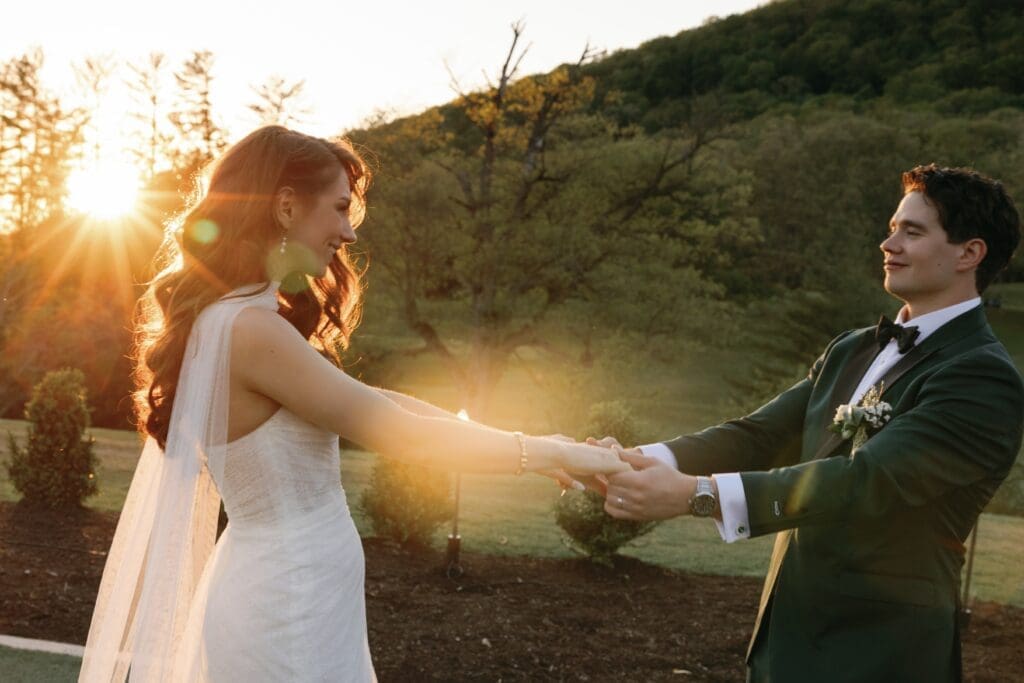
- The light gets directional. Low sun means you can backlight a couple and get a rim of gold around their hair and shoulders, or a full lens flare if that’s the mood you want.
- The light gets warm. Skin tones look healthy rather than washed out. Whites read cream instead of clinical.
For wedding portraits specifically, that combination is close to unbeatable. It’s why so many photographers will politely ask to steal you away from your reception for fifteen minutes.
When Golden Hour Happens on Your Wedding Day
This is the part that catches couples off guard: golden hour moves dramatically across the year and there’s two things worth knowing:
Golden hour is longer in summer than winter. The sun sets at a shallower angle in June, so it lingers in that low warm range longer. In December it drops fast. A December wedding might have thirty-five usable minutes. A June wedding might have seventy.
Daylight saving time creates a cliff. A wedding on the first Saturday of November has sunset around 5:10 p.m. The Saturday before, it was 6:10 p.m. Same light, one hour earlier, and a timeline built on last month’s assumptions falls apart.
Look up the exact sunset time for your specific date and venue location, not just your city. A venue in a valley or behind a treeline effectively loses light ten to twenty minutes before the official sunset time.
How Much Time You Actually Need
Less than most couples expect. Fifteen to twenty minutes is plenty.
That’s not because the light isn’t worth more. It’s because you’ll be tired, you’ll want to get back to your people, and a good photographer working in exceptional light doesn’t need an hour. Twenty focused minutes in golden hour will produce more keepers than ninety minutes at noon.
What that twenty minutes needs to include:
- Two to three minutes to walk to the location (build this in, it’s the step everyone forgets)
- Ten to twelve minutes of actual shooting
- A couple of minutes of buffer, because someone will need to fix a bustle or find a jacket
If your venue’s best light is a five minute walk away, that’s a thirty minute block, not twenty. Tell your photographer where you want to shoot before the day so the walk is accounted for.
Where It Goes in Your Timeline
Almost always, golden hour lands during dinner or right after.
That’s actually ideal. Guests are seated and occupied, nobody is looking for you, and slipping out for twenty minutes costs you nothing socially. Compare that to pulling the couple during cocktail hour, when everyone wants to talk to you.
The sequence that works most often:
- Ceremony ends
- Cocktail hour and family formals
- Reception entrance, first dance, dinner service begins
- Golden hour portraits, timed to start about forty-five minutes before sunset
- Return for toasts and dancing
If your sunset is early, a November or December wedding, golden hour may land before the ceremony even ends. In that case you’re either doing a first look and shooting portraits before the ceremony, or accepting that your portraits happen in flat afternoon light.
This is exactly why the first look question and the golden hour question are the same question for winter weddings. If getting those portraits matters to you, a first look is usually the only way to get them.
What If Your Ceremony Is at Sunset?
Sunset ceremonies are gorgeous, and they cost you golden hour portraits. You can’t be in two places at once.
Three options, honestly ranked:
Do a first look and shoot portraits earlier. You won’t get true golden light, but you’ll get relaxed, unhurried portraits and you’ll actually be present at your own cocktail hour. This is the practical choice.
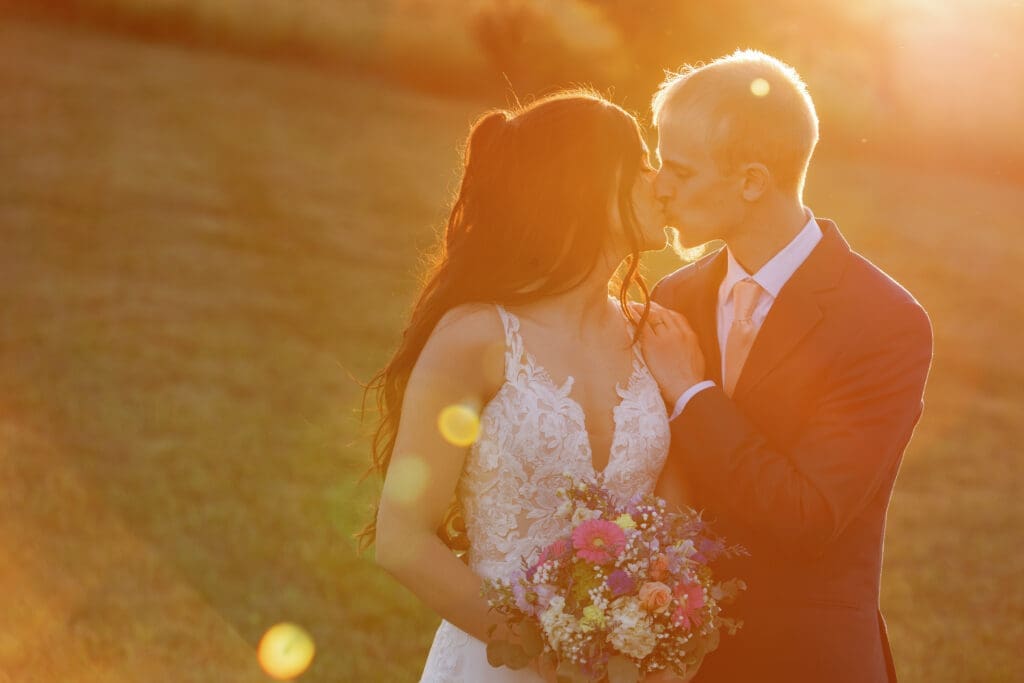
Shoot immediately after the ceremony. You’ll catch the tail of golden hour bleeding into blue hour. The light is dimmer but genuinely beautiful, and there’s an argument that portraits taken sixty seconds after you got married carry something a staged session doesn’t.
Move the ceremony thirty minutes earlier. Small change, big payoff. A 5:30 ceremony instead of a 6:00 in September gives you the ceremony in beautiful light and a portrait window afterward.
What If the Weather Doesn’t Cooperate?
Overcast is not the disaster couples assume it is.
A fully overcast sky acts as a giant softbox. You lose the gold and the flare, but you gain even, flattering light with no squinting and no harsh shadows. Some of the most beautiful portraits we’ve delivered were shot under flat gray skies.
What actually hurts is partly cloudy with a low sun, where a cloud bank sits right on the horizon and eats the light twenty minutes before sunset. There’s no fixing that except starting earlier, which is another argument for buffer time.
Rain is its own thing. A good team will have umbrellas, will shoot from a covered doorway or window light, and will ask whether you’re willing to step out for two minutes. Rain portraits tend to be either the couple’s least favorite or their absolute favorite. Rarely in between.
Blue Hour, the Underrated Sequel
Blue hour is the twenty to thirty minutes after the sun has fully set, when the sky is still lit but has gone deep blue.
It’s a completely different mood: cooler, moodier, more cinematic. Venue lights, string bulbs, and windows start reading as warm points of light against a blue sky, which is why so many venue exterior shots are taken then.
If your timeline allows, ask for five minutes at blue hour on top of your golden hour block. It’s a small ask and it produces a genuinely different set of images. It also pairs beautifully with film, since low ambient light is where the grain and warmth of our Super 8 look sits most naturally.
How to Actually Make Sure It Happens
Four things, and they take about ten minutes total:
- Look up the sunset time for your exact date and venue. Not your city, your venue.
- Put a golden hour block on the written timeline and give it to your planner and your catering manager, so nobody serves your entrée the moment you step outside.
- Ask your photographer where they plan to shoot and how long the walk is.
- Tell your DJ or band. They can hold the toasts. They cannot un-give a toast you missed.
If you’re working with us, this is a conversation we’ll start. We build the golden hour window into every timeline we help plan, and we’ll tell you honestly if your ceremony time makes it impossible so you can decide what matters more.
Frequently Asked Questions
What time is golden hour for a wedding?
Roughly the last hour before sunset, though the usable window is closer to forty-five minutes. Sunset varies enormously by season: around 5:00 p.m. in late December and just past 9:00 p.m. in late June in the northern markets we work in. Look up the exact sunset time for your specific date and venue location.
How long do golden hour wedding photos take?
Fifteen to twenty minutes of shooting is plenty, but budget closer to thirty if the location is a walk from your reception. Good light does a lot of the work, so you don’t need a long session.
Can you get golden hour photos at a winter wedding?
Yes, but the timing changes completely. A December sunset around 5:00 p.m. means golden hour may fall during your ceremony or cocktail hour rather than after dinner. Most winter couples who want these portraits do a first look and shoot earlier in the afternoon.
What if it’s cloudy on my wedding day?
Overcast skies act like a giant softbox: even, flattering light with no harsh shadows or squinting. You lose the warm gold tones but the portraits are still beautiful. The harder scenario is partial cloud sitting on the horizon, which can cut the light early.
Is golden hour worth leaving my reception for?
Almost always yes, and it costs less than couples expect. Golden hour usually lands during dinner service, when guests are seated and occupied. Twenty minutes away during dinner is the least disruptive window in the entire evening.
What’s the difference between golden hour and blue hour?
Golden hour is the low, warm light before sunset. Blue hour is the twenty to thirty minutes after the sun has fully set, when the sky is still lit but has turned deep blue. Golden hour is warm and romantic. Blue hour is cool and cinematic. If you can, get five minutes of both.
Ready to Plan Your Light?
The film at the top of this post is a real golden hour session from a wedding we filmed, and it’s the best argument we can make for putting twenty minutes on your timeline.
If you’re planning your day and want help building a timeline that actually protects the light, reach out. We film weddings across Ohio, Pennsylvania, Wisconsin, and North Carolina, and timeline guidance is part of what you get. You can see more of our work in the portfolio.
Keep Reading
- How Much Does Wedding Photography Cost? 2026 Pricing Guide — package pricing and what’s included at each tier.
- How Super 8 Lives On With Flower & Oak — the warm, grainy film look we include on every wedding film.
- Do You Need Both a Wedding Photographer and Videographer? — how golden hour plays differently in stills and in film.
